

 EN
EN  ES
ES  DE
DE How to Add a “How Did You Hear About Us” Survey in WordPress
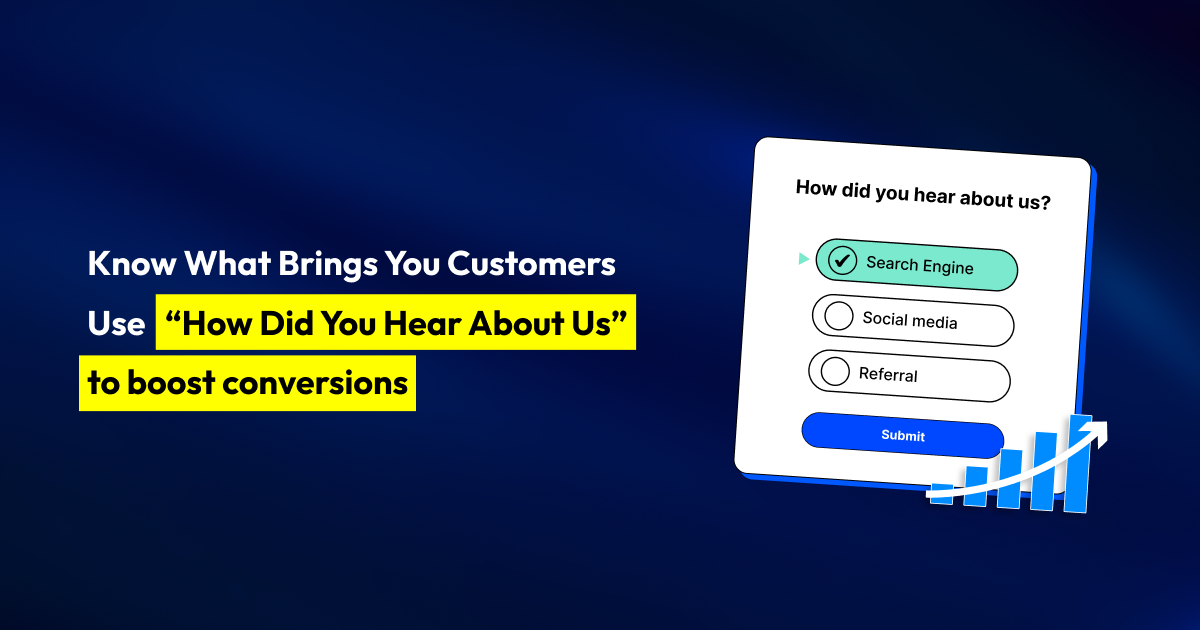
Last year on Christmas, one of my friends was discussing how her online bakery business started getting new customers. While explaining, she said she used to spend bucks on Facebook ads until she got to know how her real customers were actually coming. One day, she randomly posted on her page, asking, “How did you hear about us?”
The responses were unexpected. The majority of her customers said they came from a food blogger’s mention of her croissants. See, she had no idea until she asked. That is the thing about marketing. We, as marketers, often don’t know the real story behind improved impressions or increased sales.
That’s why the simplest way of finding it out is to run the “How Did You Hear About Us” survey, just like my friend did. It asks your customers a single question, which uncovers your best marketing channels.
So let’s learn how to create the survey form in WordPress, without writing a single line of code, how to use it, what options you should include, and where to place it on your site.
TL;DR
A “How Did You Hear About Us” survey form (HDYHAU) is one of the easiest ways to find out where your target customers are looking for your products.
- This survey form replaces marketing guesswork with real customer data.
- Best ‘How Did You Hear About Us’ survey options include Search Engine (Google, Bing, etc), Social Media (Facebook, Instagram, LinkedIn), Referral, Ads, AI Tools (ChatGPT, Claude, Gemini), and Others.
- Use form plugins like Bit Form to build your “How Did You Hear About Us” form in WordPress within minutes.
- The best spot to place this survey is at checkout, signup pages, or the end of contact forms for the maximum response rates.
- Review responses every 30 days and adjust your marketing spend accordingly.
Why the ‘How Did You Hear About Us’ Survey Matters More Than Ever for Businesses?
‘How did you hear about us’ form is a survey type form that comes with 1 or 2 simple questions that ask how users first discovered your brand, product, or service, and what their experience was, etc.
It doesn’t work like other marketing tools, like Google Analytics, that capture clicks and impressions. Instead, it collects data that is given by the user themselves.
A very specific answer to why businesses need to ask this question is to know the best customer acquisition channels.
While applying different marketing techniques, have you ever looked back and noted how and through which medium your customers come from?
Is it a social media post that boosts their curiosity? Did your earlier customer refer? Is it any ad? Or, are the search engines loving your brand?
When you use an HDYHAU form, you can understand exactly which of your marketing strategies are working.
So that you can invest in those channels only and optimise your marketing ROI.
If you have an online business, then try asking these survey questions; you’ll see the difference. Next, let’s see what answer options these customer surveys should have.
What Are the Best Options for How Did You Hear About Us Survey Form
Well, the survey forms include many options presented as radio buttons, checkboxes, or dropdowns. It is based on each business’s preferences. However, in this section, I’ll show the most common options for how did you hear about us survey form and what they mean.
1. Search Engines
Your website is search engine optimised, if people are learning about you from search engines like Google, Bing, or Yahoo! This means when anyone searches for services or products that you sell, your brand comes first compared to other suppliers.
2. Social Media Platforms
If your potential customers are coming from social media platforms, then be happy! Because your social media marketing is paying off perfectly.
So whenever you add this option, make the form condition-based. On selection, another dropdown or checkbox button presents all the popular social platforms (Facebook, Instagram, YouTube, Twitter, more). So that you can identify the platforms that your potential leads mostly come from, and invest your time and money in them.
Additionally, to attract customers, you can do influencer marketing, Facebook ads, Instagram ads, and so on. They are great lead magnets.
3. Ads
If your customers are coming to your site via online ads or TV ads, then you can rest assured that your products are reaching your target audience. Your marketing campaigns are running successfully. Now you can create more helpful products.
However, if you see no drastic change in your sales or conversions. It is better to skip ad campaigns and focus on other important sectors that’ll maximise your business ROI.
4. Friends/Family
In the modern business word-of-mouth is highly impactful. When people visit your site by hearing from friends/family, you must know you’ve built a strong brand reputation. People trust you and are advocating your brand online. So you need to work hard to keep them happy and encourage them to leave more positive reviews.
5. AI Tools
This isn’t a very common ‘how did you hear about us’ option. However, in recent times, AI Tools are working great as search engines, and people are searching more on them. So keeping an “AI chat” option is beneficial.
Suppose your product appears on AI-generated answers or AI overviews. It means your brand has great AI visibility. AI Tools like ChatGPT, Claude, and Gemini are thinking your business is leading in this niche and are recommending your product.
To improve brand visibility in AI search engines, structure your content for RAG retrieval. Like, add FAQ schema, write answer-first content, add pricing tables, and make your brand values clear.
💡Extra Tip: If you see that the “AI chat” option is getting more votes, you might add another option showing all the AI models. Then see which one is retrieving your data more.
6. Other
Most of the survey forms contain an “Other” option. This helps to find what other channels are out there that are referring your business, which you may not have considered. It allows you to capture more detailed insights about where your customers are searching for your products and services.
So by adding these amazing responses to your survey, you can make data-driven decisions and boost your marketing opportunities. With this valuable customer information, you can keep your business updated with the changing user behaviour and market trends.
Now that we know some of the best options for ‘how did you hear about us’ survey form. Time to create one.
How to Create a “How Did You Hear About Us” Form in WordPress
To create this customer survey form, you can use any modern WordPress form builder (Bit Form, WPForms, or Ninja Forms). However, one lightweight and affordable option is Bit Form.
It offers a clean drag-and-drop builder, using which you can create multi-step forms like an event registration form, and that too under $30, which is quite affordable.
Unlike other plugins, this form builder doesn’t include any recurring fees; instead, it offers LTD deals. Which is great if you have a growing business.
Step 01: Install & Activate Bit Form
Go to your WordPress dashboard. Click Plugins → then Add New → search for Bit Form.
Install it and activate it. The free version has everything you need to build this survey.

Step 02: Create a new form
After installing Bit Form, create a new form from the dashboard.
With Bit Form, you can:
- Choose a ready-made template
- Import a form
- Start from scratch
Today, we’ll start from scratch. So, select a blank form.

You can also import from a JSON file. Just click on the Import Form button and upload the JSON file. In this blog, I will share some forms that you can easily download and import to your site using the Bit Form plugin.
Step 03: Add a Radio Button with all the responses
Bit Form comes with an easy drag-and-drop builder, so creating forms is even easier.
First, drag a Radio Button field onto the canvas. This is the main attraction of your survey. Label the field, then add your answer options.

💡Tip: Use Radio Buttons if you want one answer. Use Checkboxes if people might have found you through more than one channel.
Step 04: Add the “Other” field
Here, in Bit Form’s radio button field, you get an option “Allow Other Option” with which you can add the ‘Other’ option. Whenever the user selects Other, a text box automatically appears saying “Please specify the ‘Other’ option.” Otherwise, the field stays hidden.

Step 05: Customise and Publish the form
This form plugin has an advanced style editor so you can design your ‘how did you hear about us’ survey form as you want and match your brand colours.

Moreover, you can add confirmation messages like “Thanks a lot for your response!”

Bit Form also offers a response analytics report from which you can analyse responses and find out which channel is driving more traffic.

Step 06: Connect your form to CRM or Spreadsheet
What is the point of collecting responses if they just sit in a dashboard nobody checks? Bit Form integrates with Google Sheets, HubSpot, Zoho CRM, and 50+ other tools so you can easily analyse survey data and route it to these platforms.
📑Learn how to connect your WordPress form to a CRM and make that happen.
And your survey form is ready! Have a look:
Where to Place a “How Did You Hear About Us” Survey for Maximum Responses?
This is one of the most important factors that directly affects the response rate and conversion. This is because the placement of your survey form determines whether people will answer this question or scroll it away.
The best spots are moments when users have already committed to something. Like, right after a purchase, after signing up for a newsletter, or at the end of a contact form. Or, on a thank-you page after registration.
You can also add a standalone How Did You Hear About Us form as an exit-intent pop-up that only appears to first-time visitors. This works well when you want to study where your website traffic is coming from.
One rule businesses should always follow is never to place it at the start of a form. This is a major deal breaker. And obviously, people are less likely to complete a form that opens with a question about your business. Put it at the end, where it feels like a natural closing question.
Therefore, by following these best placement strategies, you can surely ensure maximum responses.
Let’s Explore Some Common Examples of ‘How Did You Hear About Us’ Templates
Below you will find five ready-to-use “How Did You Hear About Us” templates. Each one has the same purpose, but the approach is different. You can try each one directly on this page, or you can download the template for further use.
To use them, click the Download button, extract the JSON file, and import it into your WordPress site. Once imported, your form is ready to use.
📌P.S: Here, all templates are built using Bit Form.
Multiple Choice: ‘How did you hear about our product?’ Form
This is a simple multiple-choice survey form where users can select one option. It works just like MCQs in exams, you pick the option that best fits.
Checkbox Multi-Select Survey Form
In this form, you can select multiple options. This form is useful when customers may have discovered you through more than one channel.
Dropdown list Survey form
This form contains a dropdown list with all the possible answers to an HDYHAU form. This is a conditional logic form. For example, when users select social media, another list with popular platforms appears. This is useful if you want more specific answers.
Open-ended Survey Form
This survey form is also similar to the other three, but it contains a field that allows users to type their own answer. It helps you capture insights that allow you to understand the customer journey better.
Common Mistakes That Ruin Your ‘How Did You Hear About Us’ Surveys
Apparently, most businesses set up this survey once and never think about it again. This is not how it should be. Small mistakes like this can quietly kill your response rates and make your data completely useless. Here are the ones to watch out for.
Giving People Too Many Options
There is a common myth: More choices = More submission. In real they are not. When someone sees a list of 15 or 20 options, their brain freezes. They either pick something random just to get past the question or they close the form entirely.
So, keep your list to 5-6 options maximum. Add an “Other” field for anything you missed.
Leaving Out Channels You Actually Use
Before you finalise your survey options, sit down and write out every channel your business is actually active on. If a channel is not on your list, you will never get credit for it in your data, even if it is your best performer.
Asking “Social Media” Without Asking Which One
“Social Media” as an answer tells you almost nothing. Instagram and LinkedIn have completely different audiences with completely different content.
Use conditional logic to ask a follow-up question. For example, when someone selects Social Media, corresponding questions should appear: “Which Platform?” Otherwise, this field remains hidden. This causes the form to look shorter and cleaner.
📌Note: Conditional logic forms reduce drop-offs and improve completion rate.
Hiding the Survey Where Nobody Sees It
A survey buried at the bottom of a long thank-you page is basically pointless. People are already clicking away.
Place your “How Did You Hear About Us” form at a moment when the user is still engaged.
Making It a Required Field
These questions are not meant to be “required”. We cannot force our customers to answer; this creates pressure on them. As a result, they do not think carefully and click the first option to move on, which is basically useless. So it is better to keep it optional.
Yes, you will get fewer responses, but the ones you do get will actually be honest and useful.
Not Testing It on Mobile
More than half of your visitors are on a phone right now. If your survey looks fine on a laptop but breaks on a small screen, you are losing a huge chunk of responses. Always test your form on mobile before publishing it. Check that buttons are tappable, options are readable, and nothing overlaps or gets cut off.
Collecting Responses and Never Looking at Them
You’re collecting valuable data, but not using it. The real value comes when you analyse responses and make changes, like focusing more on channels that bring customers, improving weak campaigns, or doubling down on what works.
Closing Thoughts
Sometimes we don’t need fancy analytics tools to figure out the best marketing channels. We just have to ask our customers.
A customer survey like this can do the work for you. With this form, you can not only find out how your users are learning about your brand but also check whether you are investing in the right platforms or not.
Build your How Did You Hear About Us form in minutes with Bit Form and start communicating with your audience. Review the responses regularly and align them with your marketing plan. And see how your business grows.
FAQs
What is a “How did you hear about us” survey template?
It’s a survey form that asks customers how they found your product first. This survey helps you to know more about the customer journey and improve your product marketing.
What are the ideal “How did you hear about us” survey options?
Some standard ‘how did you hear about our service” answers are Google Search, Social Media, Friend or Family Referral, Blog or Article, YouTube or Podcast, Email Newsletter, and Online Advertisement. Most importantly, adding an “Other” field is a plus; it gives you the best insights about your customer.
Why do businesses ask how did you hear about us?
Because often businesses spend the day assuming Instagram reels might be bringing traffic, Facebook ads might be attracting eyes, on this guesswork. Brands don’t get actual data. By asking this simple question, businesses can clearly understand which channels are actually driving paying customers.
Can I add an open-ended question in my “How did you hear about us” survey?
Yes, it’s a smart move. While fixed options give structure, open-ended answers often give you insights you didn’t expect, like your target users’ niche platforms or word-of-mouth sources.
Where should I add “How did you hear about us” surveys?
The best places to add this survey are when your potential customer is at the point of making a move. For example, after purchase, while making a purchase, after signing up for a newsletter, or in contact forms.
What are the “How did you hear about us” alternatives?
Instead of asking directly, you can use smarter variations like “Who referred you to us?”, “Was it easy to find us?”, or “Where do you usually discover services like ours?” These alternative questions can give deeper and more accurate insights into customer behaviour and discovery patterns.
How can I increase survey response rates?
Keep it simple and don’t force it. Place the question near the end of your form and make it easy to answer. This will significantly improve form responses.
What are the effective ways to ask customers how they found us?
Use clear and familiar wording like “How did you hear about us?” or “Where did you hear about us?” The easier it feels, the more likely people are to answer.

Related Blog

How to Prevent Spam Form Submissions in WordPress

Create a WordPress File Upload Form for Free: Beginner’s Guide

